

Tooth loss affects more than just the smile; it changes how individuals eat and speak. For patients dealing with multiple missing teeth or failing dentition, all-on-4 dental solutions offer a stable, long-term solution. It enables a full-arch restoration without the complexity of individual implants. Here is more information on these dental solutions, how they work, what issues they address, what the process involves, and the benefits:
What Are All-on-4 Dental Solutions?
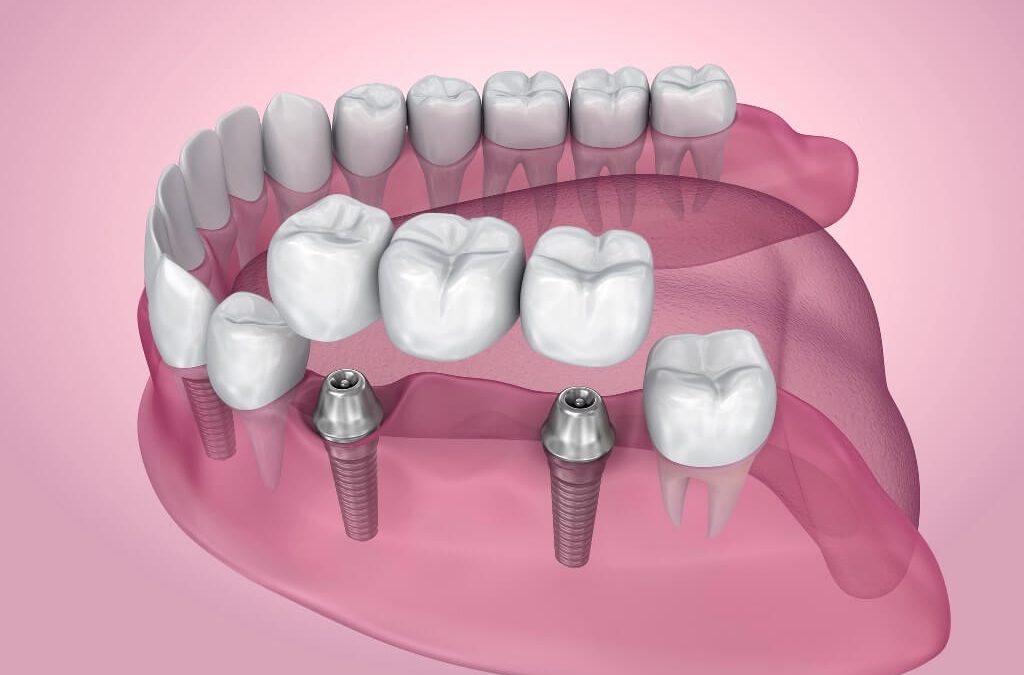
All-on-4 is a full-arch dental implant system that uses four titanium implants to support a complete set of prosthetic teeth. Unlike conventional dentures, which rest on the gums, All-on-4 prosthetics are anchored directly into the jawbone. The result is a fixed, non-removable restoration that functions and feels much like natural teeth. This system was developed to provide full-arch restorations with fewer implants, and it is beneficial for patients who may not have sufficient bone density for a full set of individual implants.
How Do They Work?
The four implants are placed at precise angles within the jawbone; two are positioned vertically at the front, and two are tilted at the back. Tilting the rear implants at an angle allows them to engage more bone surface, which improves stability. Once the implants are in place, a full-arch prosthesis is attached to the four anchor points. Since the implants integrate directly with the jawbone through a process called osseointegration, the prosthetic becomes a stable, load-bearing structure rather than a removable appliance.
What Issues Do They Address?
All-on-4 is designed to address significant tooth loss or dental failure, and it is a suitable option for patients with multiple missing teeth across an entire arch. It also helps individuals with severe tooth decay, where preservation is impractical, or with advanced gum disease leading to tooth loss. Candidates may also present with bone loss that compromises denture fit or have ill-fitting existing dentures.
A thorough evaluation by a dental professional is necessary to confirm candidacy for the procedure. The procedure is not suited for patients with active gum disease; this condition must be treated prior to implant placement. Consulting a dentist helps determine what can be done for each situation, enabling informed decision-making.
What Does the Process Involve?
Treatment begins with a comprehensive consultation; this may include imaging and a full dental assessment. This allows the dental team to evaluate bone structure, identify any pre-existing conditions, and plan implant placement with precision. Patients with gum disease or infections are treated prior to surgery, facilitating a safe procedure.
On the day of the procedure, the four implants are surgically placed under local anesthesia and sedation, which keeps the patient comfortable. A temporary prosthesis may be fitted the same day. After a healing period of several months, during which osseointegration occurs, the final permanent prosthesis is placed, and it is adjusted for fit and bite.
What Are the Benefits?
All-on-4 offers several clinically recognized advantages, including:
- Immediate function: A temporary prosthesis can be placed on the same day as surgery, reducing downtime.
- Bone preservation: The implants stimulate the jawbone, slowing bone resorption.
- Durability: With proper oral hygiene and regular dental visits, All-on-4 restorations can last many years.
Learn More From a Dentist
All-on-4 dental solutions provide a structured, evidence-based approach to full-arch tooth replacement. The procedure addresses multiple conditions, from bone loss to denture instability, and it uses a streamlined surgical process that delivers reliable, lasting results. If you are experiencing significant tooth loss, speak with a qualified dental professional.